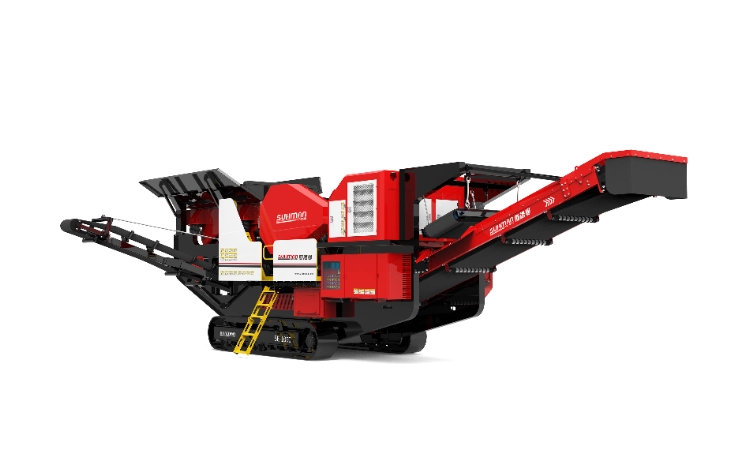



The hopper is a critical component of a mobile crushing station. To achieve uniform, continuous, and smooth material feeding, a scientifically rational hopper design is essential. The hopper must have a large capacity and incorporate anti-clogging features. This article first introduces the design and selection of hopper flow patterns. The hopper serves both storage and flow functions and can be categorized into two flow types: mass flow and funnel flow. In mass flow, all materials move uniformly toward the discharge port, with the material level descending evenly. In funnel flow, only the central portion of the material flows downward.

The hopper capacity of a mobile crushing station is determined based on the crusher’s feeding requirements to maximize intake capacity. Since material loading is intermittent while the crusher operates continuously, the hopper capacity must be calculated and selected to ensure effective coordination between feeding and loading. An oversized hopper leads to material waste, while an undersized hopper reduces material throughput, leaving the loading equipment idle for extended periods. Therefore, hopper design and selection must consider two key factors: the production capacity of the mobile crusher and the loading capacity of the transfer equipment.
The advantage of tire-type and crawler-type mobile crushing stations lies in their mobility, making them suitable for various scenarios requiring mobile operations, such as urban construction waste processing and highway construction. As highways extend, suitable materials can often be sourced locally for processing, which falls within the operational scope of mobile crushing stations.