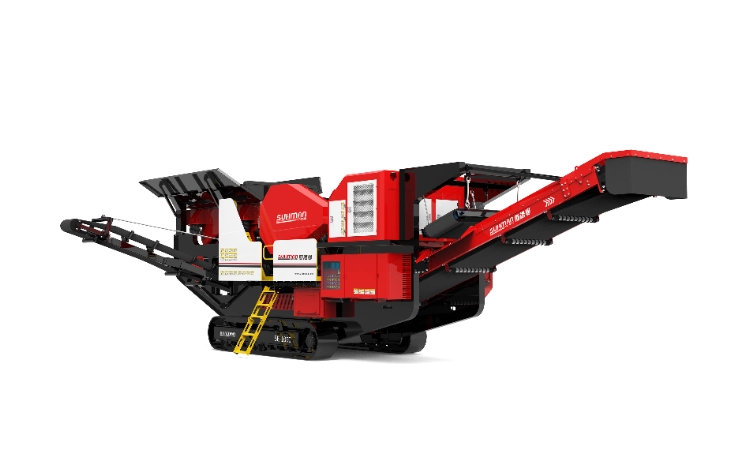



In hard rock quarries, granite and basalt are among the most abrasive materials you can crush. When your target capacity is in the 200–400 TPH range, the cone crusher becomes the key machine for achieving:
- Stable production of 0–5, 5–10, 10–20, 20–31.5 mm aggregates
- High cubicity for concrete and asphalt
- Acceptable wear cost per ton
This guide explains which types of cone crushers are suitable for 200–400 TPH granite and basalt, how they work inside a mobile crushing line, and how quarry owners and contractors can choose the right model for their project.
Tip for your site:在“cone crusher 产品页”和“mobile crushing plant 分类页”加内链。
1. Typical Requirements for 200–400 TPH Granite & Basalt Lines
When customers contact us for a cone crusher for hard rock, their requirements usually look like this:
- Feed material:
- Fresh granite or basalt, compressive strength 120–220 MPa
- Abrasive, with high quartz content
- Feed size to cone:
- 0–150 mm or 0–200 mm, coming from a primary jaw crusher
- Final products:
- 0–5, 5–10, 10–20, 20–31.5 mm for concrete and asphalt
- Sometimes 0–3 mm sand or 31.5–50 mm ballast as additional fractions
- Capacity:
- 200–250 TPH for medium-sized quarries
- 250–320 TPH for typical commercial quarries
- 320–400 TPH for larger operations and export stone
In most of these cases, the cone crusher works in a closed circuit with a 3-deck screen inside a track-mounted mobile line:
- Mobile jaw crusher →
- Mobile cone crusher →
- Mobile 3-deck screening plant with recirculating conveyor
2. Main Cone Crusher Types for Hard Rock (Granite / Basalt)
For 200–400 TPH granite and basalt, we normally consider 3 cone configurations:
2.1. Standard Cone (Medium / Coarse Chamber)
- Purpose: secondary crushing after a jaw
- Typical feed size: up to 200 mm
- CSS range: 18–30 mm
- Output: 0–40/0–50 mm for further screening or tertiary crushing
This setup is used when:
- You want higher capacity and don’t need a lot of 0–5 mm;
- You accept a higher percentage of 20–40 mm for ballast or sub-base;
- You plan to add another cone or VSI as a tertiary stage later.
2.2. Medium-Fine Cone for Closed Circuit (Most Common)
- Purpose: secondary/tertiary in one step
- Feed size: 0–150/0–200 mm
- CSS range: 10–25 mm
- Output: mainly 0–31.5 mm, with oversize returning to the cone
For 200–400 TPH granite/basalt mobile lines, this is the most widely used type because:
- It gives a good balance between capacity and product shape;
- It works well in closed circuit with a 3-deck screen to produce 0–5, 5–10, 10–20, 20–31.5 mm;
- You can adjust CSS and speed to fine-tune shape or capacity.
2.3. High-Speed Fine Cone for More Sand
Some projects require more fines (0–5 mm) for concrete or asphalt. In these cases, a high-speed cone with a fine chamber can be used:
- CSS range: 8–18 mm
- Target: more 0–5 and 5–10 mm, less 20–31.5 mm
- Wear: higher, but acceptable if sand has good value
This configuration is common when:
- Natural sand is limited;
- The quarry sells manufactured sand at a premium;
- There is a dedicated market for high-quality concrete aggregates.
3. Where the Cone Crusher Sits in a 200–400 TPH Mobile Line
A typical mobile hard rock line for granite/basalt looks like this:
- Primary: Mobile Jaw Crusher
- Feed: 0–600/700 mm from blasting
- CSS: 120–180 mm
- Output: 0–150/0–200 mm
- Secondary/Tertiary: Mobile Cone Crusher
- Feed: 0–150/0–200 mm from jaw
- CSS: 10–25 mm depending on required product
- Output: 0–31.5 mm
- Final Sizing: 3-Deck Mobile Screening Plant
- Top deck: 31.5/25 mm
- Middle deck: 20 mm
- Bottom deck: 10 or 5 mm
- Products:
- Oversize (>25/31.5 mm) → returns to cone
- 20–31.5 mm
- 10–20 mm
- 5–10 mm
- 0–5 mm
In this layout, the cone crusher is the heart of the system:
- If the cone is too small → bottleneck, frequent overload, poor shape;
- If the cone is oversized but not properly adjusted → low utilization, high cost per ton.
4. How to Size a Cone Crusher for 200–400 TPH Hard Rock
When we size a cone for granite and basalt, we look at several key points.
4.1. Required Capacity in Closed Circuit
The nameplate capacity of a cone crusher is usually for open circuit and softer rock. For hard granite/basalt in closed circuit, you must consider:
- Realistic capacity is often 70–80% of theoretical;
- Part of the material circulates as oversize;
- Finer CSS gives better shape but lower throughput.
Example (for illustration):
- If you need 250 TPH final products on granite, the cone may need to run at 300–320 TPH in closed circuit to allow for circulation.
4.2. Feed Size from the Jaw Crusher
- For 200–250 TPH lines, a jaw with 900×600 mm feed opening and CSS 120–150 mm is usually enough;
- For 300–400 TPH lines, an 1060×700 mm or 1100×700 mm jaw with CSS 150–180 mm is more suitable.
The cone crusher should not be forced to crush too many big pieces. A more even 0–150 mm feed extends liner life and improves shape.
4.3. Final Products and CSS
- If you need a lot of 0–5 and 5–10 mm, you will run the cone at a tighter CSS (10–16 mm);
- If your market prefers 10–20 and 20–31.5 mm, a slightly wider CSS (16–22 mm) will give better capacity and lower wear.
The right CSS depends on:
- Market demand for each size;
- Abrasiveness of the rock;
- Required shape (more cubic for asphalt).
5. Liner Selection for Granite & Basalt
For abrasive rocks, the right liner profile is critical.
5.1. Medium vs Fine Profile
- Medium profile liners:
- Balanced capacity and reduction ratio;
- Good choice when you want both 10–20 and 20–31.5 mm.
- Fine profile liners:
- Higher reduction ratio, more fines;
- Useful when you want more 0–5/5–10 mm and less coarse aggregate.
5.2. Material and Hardness
Most modern cone liners for granite/basalt use high-manganese steel with different hardness levels. In general:
- Harder liners → longer life but more sensitive to improper feed and tramp metal;
- Softer liners → more tolerant to impact but wear faster in abrasive material.
For a 200–400 TPH granite line, we usually:
- Recommend proper choke feeding to protect liners;
- Suggest a spare set of liners to reduce downtime;
- Provide guidance on when to turn or change liners based on wear pattern.
6. Advantages of Mobile Cone Crushers for Granite & Basalt
Compared with a stationary plant, a track-mounted mobile cone brings several advantages for quarry owners and contractors:
6.1. Less Civil Work, Faster Start-Up
- No massive foundations or tall steel structures
- Installation often within days instead of months
- Easier relocation between benches as the face advances
6.2. Shorter Hauling Distance
By moving the mobile jaw and cone closer to the face:
- Loaders and trucks travel less distance
- Fuel consumption and tyre wear go down
- Overall cost per ton is reduced
6.3. Flexible Capacity and Product Mix
- You can start with 200–250 TPH and upgrade to 300–400 TPH by adjusting:
- CSS, liner profile, screen openings;
- Or adding a second cone or extra screen when needed.
6.4. Better Resale Value and Re-Use
- Mobile units can be moved to new sites or contracts;
- They are easier to sell on the second-hand market than a fixed plant.
7. Cost Considerations (CAPEX & OPEX)
The total cost of a 200–400 TPH granite/basalt line with mobile cone crusher depends on:
- Jaw, cone and screen sizes
- Number of conveyors and stockpile configuration
- Power source (diesel-electric, hybrid, or full-electric)
- Local freight, import duties and installation conditions
Instead of giving “one price fits all”, we typically:
- Design 2–3 alternative setups (e.g. 200–250, 250–320, 320–400 TPH);
- Estimate required power and fuel consumption;
- Show the difference in cost per ton between smaller and larger layouts.
8. What Information You Should Send Before Choosing a Cone Crusher
To help you choose the right cone crusher for 200–400 TPH granite or basalt, we usually ask for:
- Rock photos & description
- Photos of the face and single stones
- Brief description of hardness and abrasiveness
- Required capacity and working hours
- Target TPH on final products
- Operating hours per day and days per year
- Required final sizes
- Standard: 0–5, 5–10, 10–20, 20–31.5 mm
- Any special sizes: ballast, crusher run, sands
- Site layout & power supply
- Available space and levels
- Diesel only or grid connection
With this information, we can:
- Recommend suitable cone crusher models and chamber types;
- Match them with the right mobile jaw and screening plant;
- Provide layout drawings and technical data sheets;
- Prepare a factory-direct quotation for your project.
9. Request a 200–400 TPH Cone Crusher Proposal for Your Quarry
If you are planning or upgrading a granite or basalt line in the 200–400 TPH range, a properly sized cone crusher in a mobile circuit can dramatically improve:
- Capacity and product consistency
- Shape for concrete and asphalt
- Overall cost per ton and flexibility between benches
Get Your 200–400 TPH Cone Crusher Solution
- Send us: rock photos, feed size, required TPH and final sizes
- We will come back with:
- Recommended jaw + cone + screen models
- Expected capacity and product split
- Layout drawing and factory-direct offer