


Construction Waste and Mobile Crushers: A Comprehensive Solution
Construction waste is the solid waste generated during the construction, renovation, expansion, or demolition of buildings. As cities continue to grow, the amount of construction waste increases rapidly—especially with the acceleration of urbanization, such as the renovation of urban villages, road construction, and modern infrastructure development.
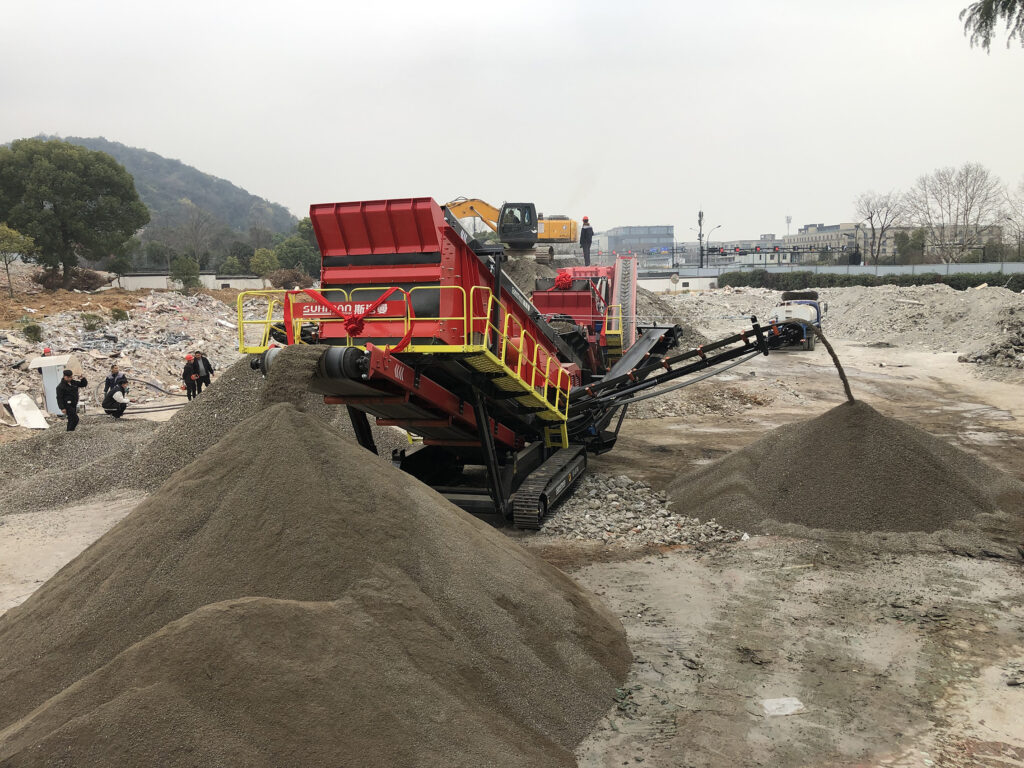
Traditional landfill methods are far from sufficient to handle such large-scale waste, making construction waste a stubborn problem in urban environmental management.
Mobile Crushers: A Modern Recycling Solution
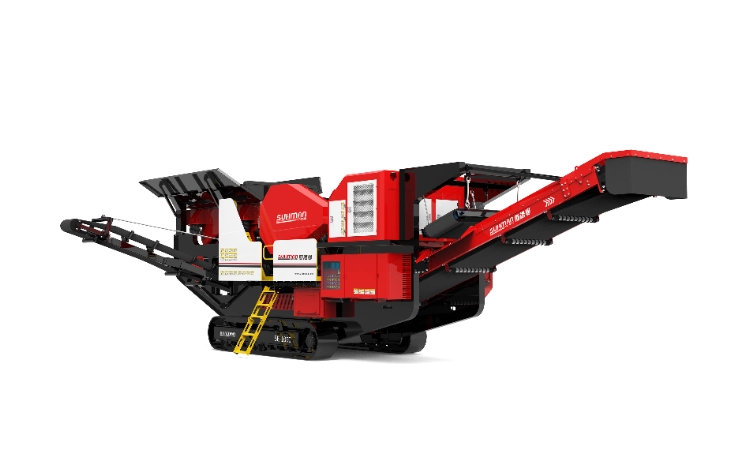
Mobile crushers are a new type of crushing equipment. They integrate advanced vehicle-mounted mobility technology to achieve mobile operations. Crushing, screening, feeding, and other equipment are combined on a boat-shaped steel frame to form an independent production line.
They can crush construction waste into suitable sizes and screen different particle sizes to meet various production requirements. The recycled materials can then be reused in other industries, giving construction waste a new life and allowing for the reallocation of valuable resources.
The mobile construction waste crusher is an essential machine for recycling and reuse in urban waste recovery. It processes construction waste and transforms it into reusable resources. Its emergence effectively addresses long-standing challenges left behind by rapid urban development and contributes to promoting green city growth. As a result, mobile crushers are highly favored by investors and users in the current market.
Advantages of Mobile Crushers in Construction Waste Recycling
1. Multiple Configuration Options for Broader Applications
Mobile crushers come with various configuration options. Depending on project needs, they can be equipped with jaw crushers, impact crushers, cone crushers, hammer crushers, sand-making machines, etc.
They can process not only construction waste but also various ores, making them widely used in construction, building materials, road, railway, and bridge industries.
2. Strong Mobility and Powerful Drive
Mobile crushers feature advanced drive systems with powerful engines. They come in two mobility types: tire-mounted and crawler-mounted. These machines have strong adaptability to different terrains and excellent climbing abilities.
They are not limited by the worksite and can move along with material stockpiles, saving time and cost on foundation installation and disassembly, ultimately reducing production expenses.
3. High Level of Automation
Mobile crushers are self-contained production lines with a high degree of automation. They are equipped with PLC centralized control systems, enabling remote intelligent monitoring and operation. Users can monitor machine status in real time and adjust production instructions as needed.
5 Key Factors to Consider When Choosing a Mobile Crusher
Mobile crushers are key equipment in semi-continuous open-pit mining and are ideal for processing construction waste. However, many users are unsure how to choose the right machine. Below are five key factors to consider:
1. Crushing Capacity Requirements
Different processing capacities require different crusher models.
- The crusher’s processing capacity is influenced by the feeder’s delivery rate. For example, if the crusher is rated at 450 m³/h but the feeder cannot deliver that volume, the entire crushing station’s capacity will be limited.
- When selecting plate feeders, consider the maximum input particle size. The feeder width must be slightly larger than the input size; otherwise, materials may jam the chute and prevent proper discharge into the crusher.
- Hopper volume also affects crushing capacity. A hopper that is too small will be emptied quickly by the feeder. If trucks cannot replenish materials in time, it results in idle time and reduced output.
2. Understanding Available Supporting Equipment
Before designing a mobile crushing station, it’s essential to understand the supporting equipment available at the open-pit site. Common supporting equipment includes electric shovels, trucks, crawler carriers, and bulldozers.
- Electric shovels and trucks are short-distance transport tools. Their capacity must match that of the crusher to ensure smooth operation and prevent resource waste.
- Crawler carriers and bulldozers are used for relocating the mobile station. If their transport capacity is not considered, the station’s design may fail.
3. Equipment Usage Conditions
Most mobile crushers are used in open-pit mines. In some regions, extreme winter temperatures may reach -20°C to -40°C. The design must account for cold resistance of materials.
Additionally, local earthquake levels, wind strength, and snow thickness must be considered. These natural forces impose seismic, wind, and snow loads on the steel structure, which must be accounted for in the station’s material and structural design.
4. Relocation Cycle of the Crushing Station
The frequency at which the station needs to be relocated determines the structural design.
- Short relocation cycles (every 3–6 months):
The structure must allow for easy and frequent moves, and adapt to terrain changes. These stations often use trestle-style foundations, avoiding expensive concrete retaining walls and instead utilizing simple walls and steel structures. Natural slopes and hoppers can also be used to reduce costs. - Long relocation cycles (every 1–3 years):
Require more stable and permanent structures. These stations typically involve large reinforced concrete retaining walls and must be designed to support truck loads and hopper placement.
5. Coordination of Equipment Angles and Distances
The most critical part of designing a mobile crushing station is the coordination between three main components: the feeder, crusher, and conveyor.
The distance and height between the feeder and crusher depend on material flow and processing requirements. The feeder usually has a downward angle relative to the ground to better control material flow and layer thickness.
A 15° angle is typically ideal.
- Too steep an angle increases motor power consumption.
- Too shallow an angle affects vertical space between the crusher and conveyor.
Conclusion: Mobile Crushers Drive the Circular Economy
The construction waste recycling industry is a new and growing sector that embodies clean production, waste transformation, and circular resource use.
Mobile crushers provide high-quality recycled materials for urban construction, reduce the environmental impact of waste, and play a critical role in recycling construction waste and turning it into valuable resources.
Today, construction waste recycling facilities are at the forefront of industrial innovation and represent a rising trend in investment. Choosing the right mobile crusher is key to success.
📩 If you would like more information or to consult on equipment options, feel free to leave a message on our website.
We’ll get back to you with tailored solutions.