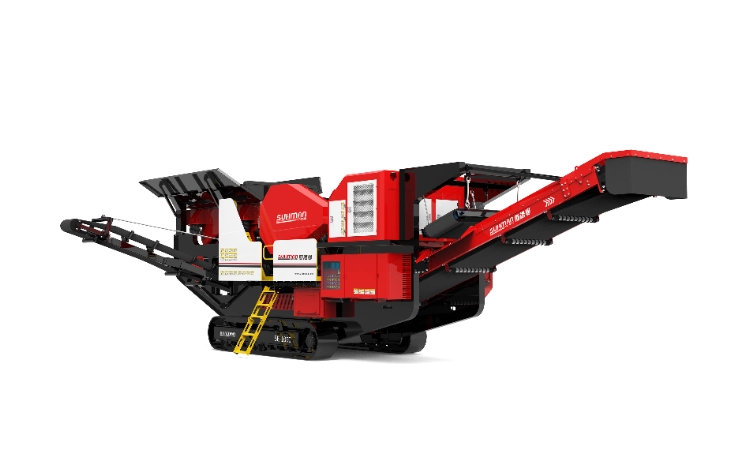



For most granite quarries, the core business is simple:
stable production of 0–5, 5–10 and 10–20 mm aggregates with consistent shape and gradation for ready-mix concrete, asphalt and railway projects.
A track-mounted mobile crusher line is often the fastest way to achieve this, especially when benches are changing and the face is moving. This article explains how to configure a mobile crusher for granite quarry to produce 0–5, 5–10 and 10–20 mm in one closed circuit, what capacity you can expect, and what to consider before sending an RFQ.
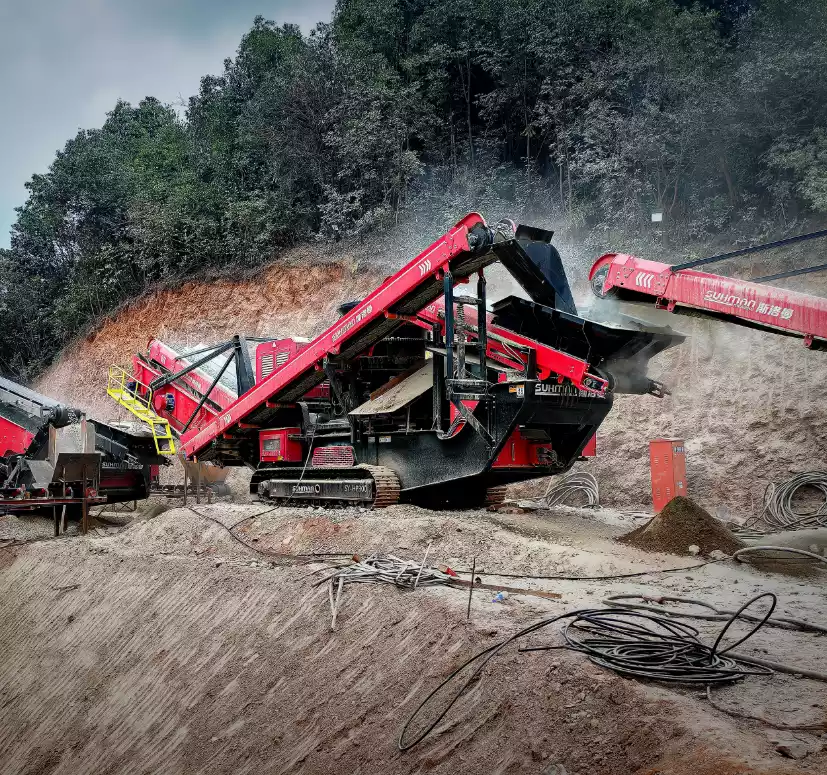
1. Typical Requirements in a Granite Quarry
In real projects, granite quarry owners and contractors usually ask for:
- Final sizes:
- 0–5 mm (manufactured sand)
- 5–10 mm (small aggregate)
- 10–20 mm (standard coarse aggregate)
- Sometimes 20–31.5 mm or 20–40 mm as an additional product
- Feed material:
- Hard granite, compressive strength 120–200 MPa
- Maximum feed size 400–700 mm depending on the face and blasting
- Capacity range:
- Small to medium quarry: 120–200 TPH
- Medium to large quarry: 200–350 TPH
- Larger operations: 350–450 TPH
- Operation mode:
- Direct loading by excavator or wheel loader
- Short moves between benches or stockpile areas
- Limited civil work, fast installation and relocation
This is exactly where a mobile jaw + mobile cone + 3-deck screening plant performs best.
2. Recommended Mobile Crushing Layout for 0–5, 5–10, 10–20 mm
A proven setup for granite looks like this:
- Track-mounted mobile jaw crusher (primary)
- Track-mounted mobile cone crusher (secondary/tertiary)
- Track-mounted 3-deck screening plant (final sizing)
2.1. Primary: Mobile Jaw Crusher
Function:
Crush blasted granite from 0–600 mm down to 0–150/0–200 mm.
Key parameters:
- Feed opening: 900×600 mm to 1100×700 mm (depending on required TPH)
- Capacity: 150–350 TPH on granite
- Discharge setting (CSS): typically 120–180 mm
- Output: well-graded 0–150/0–200 mm material for the cone crusher
Why jaw as primary?
- Handles big, irregular blocks from the face
- Lower wear cost compared with using a cone as primary
- Simple, robust and easy to maintain in quarry conditions
2.2. Secondary/Tertiary: Mobile Cone Crusher
Function:
Take 0–150/0–200 mm feed from the jaw and reduce it to 0–25/0–32 mm for screening.
Key parameters:
- Cone chamber: medium or fine type for hard rock (granite)
- Feed size: up to 200 mm
- Capacity: 150–350 TPH depending on chamber and CSS
- CSS: typically 16–25 mm for good cubic shape
For granite 0–5, 5–10, 10–20 mm, the cone should work in a closed circuit with the screen:
- Screen oversize (>20–25 mm) returns to the cone via recirculating conveyor
- Screen mid-size and fines (0–5, 5–10, 10–20 mm) go to separate conveyors and stockpiles
2.3. Final Sizing: 3-Deck Mobile Screening Plant
Function:
Precisely split the cone crusher output into 0–5, 5–10, 10–20 mm (and oversize).
Typical deck setup:
- Top deck: 20 mm or 25 mm
- Middle deck: 10 mm
- Bottom deck: 5 mm
Product flows:
- Oversize from top deck (>20/25 mm): return to cone crusher
- 10–20 mm: between 10 mm and 20/25 mm on middle deck → coarse aggregate
- 5–10 mm: between 5 mm and 10 mm on bottom deck → small aggregate
- 0–5 mm: underflow from bottom deck → manufactured sand
Advantages of a dedicated 3-deck screen:
- Stable grading for each size
- Easy adjustment by changing mesh or apertures
- Possibility to add 20–31.5 mm or 20–40 mm as a fourth product when needed
3. Capacity Examples for Granite 0–5 / 5–10 / 10–20 mm
Below are common configuration ranges you can use as a reference when requesting a quotation.
3.1. 150–200 TPH Line (Small to Medium Quarry)
- Feed: 0–500 mm granite
- Primary: mobile jaw 900×600 mm
- Secondary: mobile cone with medium-fine chamber
- Screen: 3-deck, 4.5×1.5 m or similar
Typical product split:
- 0–5 mm: 20–25%
- 5–10 mm: 20–25%
- 10–20 mm: 35–45%
- Oversize: 5–15% (recirculated)
3.2. 250–300 TPH Line (Standard Commercial Granite Quarry)
- Feed: 0–600 mm granite
- Primary: mobile jaw 1060×700 mm or similar
- Secondary: high-capacity mobile cone
- Screen: 3-deck, 6×1.8 m or 6×2.0 m
Typical product split:
- 0–5 mm: 20–30%
- 5–10 mm: 20–25%
- 10–20 mm: 30–40%
- 20–31.5 mm (optional): 5–15%
This is a very common setup for region-level granite quarries that supply multiple concrete plants, asphalt plants and precast factories.
3.3. 350–400 TPH Line (Large Hard-Rock Operation)
- Feed: 0–650/700 mm granite
- Primary: heavy-duty mobile jaw (1100×700 mm or larger)
- Secondary: larger mobile cone, possibly with pre-screen
- Screen: 3-deck, 6×2.1 m or larger
Such a line can support:
- Large commercial quarries
- Export of crushed stone by rail or ship
- Multiple products (0–5, 5–10, 10–20, 20–31.5, 31.5–50 mm) with very high throughput
4. Key Points to Check Before Sending an RFQ
To receive an accurate offer for a mobile crusher for granite quarry 0–5, 5–10, 10–20 mm, try to prepare the following information:
- Material
- Rock type: granite (coarse, fine-grained, weathered?)
- Bulk density (approx.), presence of clay or soil
- Feed size and source
- Maximum feed size (e.g. 500 mm, 600 mm, 700 mm)
- Source: blasted rock, loader bucket size, excavator model
- Required capacity
- Target capacity in TPH for average operation
- Peak capacity during high season
- Required final sizes and proportion
- 0–5 / 5–10 / 10–20 mm as standard
- Any additional products (e.g. 20–31.5 mm, ballast, crusher run)
- Site conditions
- Bench height and distance between benches
- Haul road conditions and maximum gradient
- Power source: grid connection, generator, or diesel-only
- Local regulations
- Dust and noise limits
- Any specific requirements on guarding and safety devices
With these details, a supplier can optimize:
- Jaw model and CSS
- Cone chamber and speed
- Screen size and deck configuration
- Conveyors, recirculating loop and stockpile arrangement
5. Why Choose a Track-Mounted Mobile Line Instead of Stationary?
For granite, stationary plants are common, but track-mounted mobile crushers offer clear advantages in many projects:
- Less civil work & faster startup
- No large foundations, no heavy steel structures
- Shorter installation time, often within days
- Flexibility between benches
- Follow the blasting face to reduce hauling distance and fuel consumption
- Move between satellite pits or temporary stockpile areas
- Better resale and redeployment value
- Machines can be moved to new contracts or resold more easily
- Suitable for contractors and quarry groups with multiple sites
- Modular upgrades
- Start with jaw + cone + screen
- Add a second cone or extra screen later as demand grows
6. How We Can Help Configure Your Granite Quarry Line
If you are planning to produce 0–5, 5–10 and 10–20 mm granite aggregates with a mobile crusher line, we can:
- Analyze your feed material, face conditions and local market requirements
- Recommend 150–200, 250–300 or 350–400 TPH configurations with concrete model numbers
- Provide layout drawings showing how jaw, cone and screen work together in closed circuit
- Offer factory-direct pricing, shipping solutions and spare parts support for your region
7. Request Your Mobile Granite Crusher Proposal
To get a tailored solution, you only need to send:
- Your required capacity (TPH)
- Feed size range and a few photos of the rock
- Required final sizes (0–5, 5–10, 10–20 mm, plus any others)
- Destination port or country
We will prepare a complete proposal including:
- Recommended mobile jaw, cone and screening models
- Estimated capacity and fuel consumption
- Layout drawing for your granite quarry
- Delivery time and commercial terms