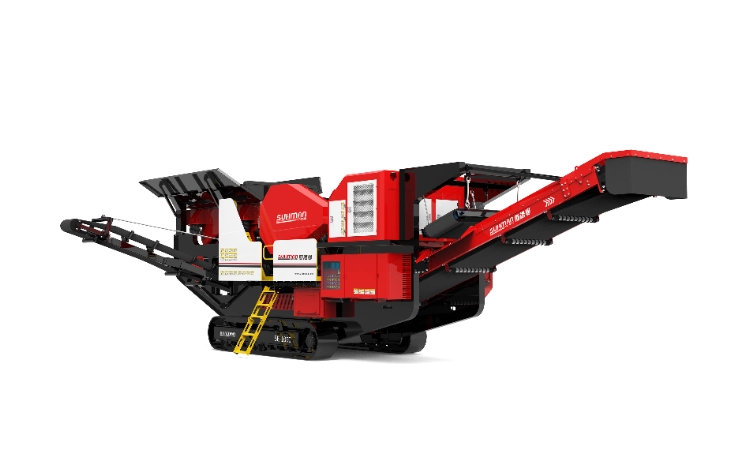



Understanding Key Parameters of a Mobile Crusher: Feed Opening, Chamber Type, CSS and Real Capacity
When clients ask us how to choose a tracked mobile crusher, the first question is often about model number or rated capacity. In practice, this is exactly where many projects start to go off track.
We have seen mobile crushing plants underperform, not because the machine was poorly built, but because key parameters were misunderstood or ignored at the selection stage. Feed opening, chamber type, CSS and real working capacity may look like technical details, yet they directly decide whether a crushing line runs smoothly or struggles every day on site.
This article breaks down these parameters from a practical, on-site perspective—based on real quarry and construction projects.

1. Feed Opening: Where Capacity Problems Usually Begin
Feed opening defines the largest stone size a crusher can accept continuously, not just occasionally.
One common mistake we see in hard rock projects is choosing a jaw crusher based on nominal capacity, while ignoring the real blasted stone size. Oversized feed leads to bridging, unstable feeding and sudden throughput drops—even when everything looks fine on paper.
From experience:
- The maximum feed size should stay within 80–85% of the jaw opening.
- Consistently oversize feed causes liner damage and frequent blockages.
- Bigger feed openings do not automatically mean higher output if downstream units cannot absorb the material.
In granite and basalt quarries, properly matching feed opening to blast design is often the first step to stabilizing production.
2. Crushing Chamber Type: A Frequent Source of Mismatch
Crushing chambers are designed to balance gripping force, reduction ratio and material flow. Choosing the wrong chamber is one of the most overlooked configuration errors.
Jaw Crusher Chambers
- Standard chambers suit most primary crushing applications.
- Long or fine chambers increase reduction and fine material output but may limit throughput if not matched correctly.
Cone Crusher Chambers
- Coarse chambers favor capacity and reduce fines.
- Medium chambers balance output and product shape.
- Fine chambers improve particle shape but reduce total tonnage.
We often see cone crushers running fine chambers in hard granite simply to chase finer output—only to struggle with overloading and excessive liner wear. Chamber selection should always follow material hardness and downstream requirements, not just target size.
3. CSS: A Small Adjustment That Changes Everything
CSS (Closed Side Setting) determines the minimum discharge gap in the crushing chamber. It is adjustable, yet rarely optimized properly on site.
In real projects:
- Setting CSS too tight produces finer material but accelerates wear.
- Setting CSS too wide increases capacity but may miss target gradation.
We have reviewed projects where a slight CSS change improved throughput significantly without touching the machine itself. CSS should always be adjusted as a balance between required product size, capacity and operating cost per ton—not set blindly at the minimum.
4. Real Capacity vs Rated Capacity: Why the Numbers Don’t Match
Rated capacity figures are tested under ideal conditions. Real quarry conditions are rarely ideal.
Actual capacity is affected by:
- Material hardness and abrasiveness
- Feed consistency
- Pre-screening efficiency
- Operator habits
- Coordination between crushing and screening units
For example:
- A 300 TPH rated plant may realistically deliver 260–280 TPH in hard granite.
- The same setup may exceed rating in limestone or recycled concrete.
Understanding this reality helps avoid under-sizing equipment or pushing machines beyond reasonable operating limits.
5. Why These Parameters Must Work as a System
A mobile crushing line fails when parameters are chosen individually rather than as a system.
Typical real-world issues include:
- Large jaw opening feeding into an undersized cone.
- Tight cone CSS combined with insufficient screening area.
- No pre-screening, wasting energy crushing fines.
In well-performing projects, feed opening, chamber selection, CSS and screening capacity are coordinated from the start, based on material behavior and production goals, not just model numbers.
6. What We Usually Ask Before Recommending a Configuration
Before proposing any mobile crusher configuration, we normally ask clients to prepare the following information:
- Material type (granite, basalt, limestone, concrete, etc.)
- Maximum feed size
- Target final product sizes
- Required production rate (TPH)
- Working conditions (relocation frequency, site constraints)
With this data, it becomes much easier to define the correct feed opening, chamber type, CSS range and overall plant layout.
Most mobile crusher performance issues are not mechanical—they are configuration-related. Feed opening, chamber type, CSS and real capacity determine how efficiently a crushing plant runs, how often it stops, and how much it costs to produce each ton of material.
Ready to Talk About Your Next Mobile Crusher Project?
Choosing a tracked mobile crusher is not just about the brochure data. It is about whether the plant can really crush your material, hit your target capacity and keep running stably for years with reasonable wear cost.
If you are planning a 100–450 TPH hard rock or C&D project, you can send us a few key details:
- Project location and working conditions (quarry, tunnel, demolition, recycling, etc.)
- Material type and hardness (granite, basalt, limestone, river stone, concrete, mixed C&D)
- Required capacity (TPH) and working hours per day
- Maximum feed size and the final sizes you want to produce
- Preferred configuration (jaw + cone, jaw + impact, with/without pre-screening, etc.)
Based on this, SUHMAN can suggest a practical tracked mobile crushing and screening configuration, estimate the investment level and outline delivery time from our factory in China. No generic “one model fits all” answer – just a realistic solution for your site and your budget.