


Gravel can be classified from different perspectives. Below are some common classification methods and types:
Classified by Particle Size
- Fine Gravel: Average particle size between 1–10 mm.
- Coarse Gravel: Average particle size between 10–100 mm.
- Boulder: Average particle size greater than 100 mm.
Classified by Roundness
- Conglomerate: Gravel with more than 50% rounded and sub-rounded particles.
- Breccia: Gravel with more than 50% angular and sub-angular particles.
Classified by Composition
- Monomict Conglomerate: Gravel with a single composition, where a single type of gravel accounts for more than 75%. These are often composed of stable rock or mineral fragments, such as quartzite conglomerate, flint conglomerate, and quartz conglomerate.
- Polymict Conglomerate: Gravel with complex composition, where no single type exceeds 50%. These typically have poor sorting and roundness, and lower resistance to weathering, often resulting from alluvial deposits.


Classified by Genesis (Origin)
- Littoral Conglomerate: Mainly formed in coastal or lakeside areas, originating from river-transported gravels or fragments of rocks collapsed from shorelines, shaped by repeated wave and river action.
- Fluvial Conglomerate: Formed by mountain or plain rivers, usually composed of lithic gravels. These gravels tend to be larger than marine gravels but have poorer sorting.
- Alluvial Conglomerate: Formed when mountain torrents emerge from valleys into plains, causing a rapid drop in flow speed and deposition of coarse debris at the mountain base. Gravels are larger, poorly sorted, and have low roundness.
- Glacial Breccia (Tillite): Also known as glacial till, with complex composition and unstable fresh components. Very poorly sorted, gravels are mostly angular, often with multiple planar surfaces. Stratification is unclear, and the deposit is usually massive.
- Collapse Breccia: Formed at steep terrain boundaries due to landslides or rockfalls. Both angular breccia and rounded gravels may coexist, with very poor sorting and highly variable gravel sizes.
- Karst Breccia: Also known as cave breccia, associated with the dissolution of underlying materials and collapse of overlying strata. Angular fragments are often slab-shaped or consist of variously sized limestone blocks, with a carbonate matrix or weathered red clay.
- Volcanic Breccia: Rock formed by volcanic clastic materials between 2–64 mm, cemented by fine debris. Gravels are mostly angular, poorly stratified, and poorly sorted, all bonded by volcanic materials.
- Fault Breccia (Tectonic Breccia): Formed under stress when original rocks fracture into angular fragments, filled or cemented by fine crushed debris or external materials. The fragments come from rocks on both sides of the fault; cement is composed of rock powder, fault gouge, or hydrothermal substances.
- Hydrothermal Explosion Breccia: Formed when hydrothermal pressure exceeds the lithostatic pressure, causing volatile substances to escape violently, rapidly expanding in volume and resulting in hydrothermal explosions. The breccia often shows circular, elliptical, or banded morphology.
- Magmatic Explosion Breccia: Occurs in shallow or ultra-shallow environments where overlying rock pressure is less than the magmatic explosion threshold. Formed through explosive or volcanic activity. Fragments are complex, typically including wall rock and deep-seated clasts brought up by magma, with fine-grained magmatic material as cement.
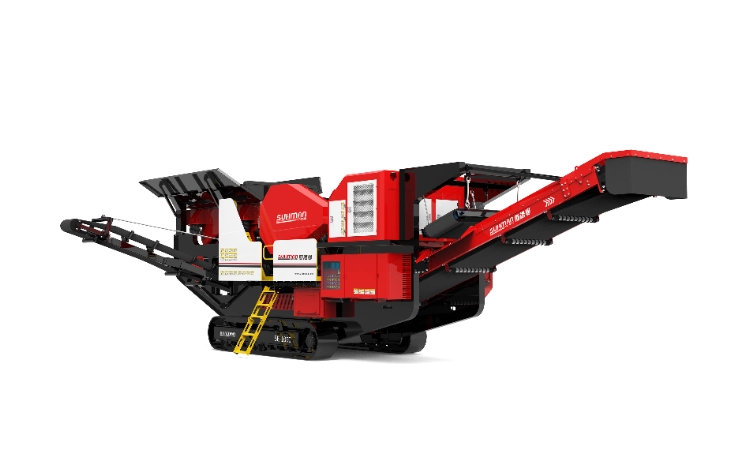
✅ Why Use a Mobile Crusher for Gravel?
| Feature | Explanation |
|---|---|
| Abundant raw material | Gravel is commonly found in rivers, hillsides, alluvial fans, and glacial deposits |
| On-site mobility | Mobile crushers can be deployed directly at the site with no foundation work |
| Built-in screening | Integrated crushing and screening systems deliver multi-spec aggregates |
| High-value products | Crushed gravel can be used as concrete aggregate, road base, and sand |
🚜 Recommended Equipment Combinations for Gravel Processing
| Process Stage | Equipment Configuration | Description |
|---|---|---|
| Primary Crushing | Mobile Jaw Crusher (e.g., SE-1060) | Reduces large gravel or boulders to below 100mm |
| Secondary Crushing | Mobile Impact or Cone Crusher | Refines shape and particle size for high-quality aggregates |
| Screening | Mobile Screening Unit / Integrated Vibrating Screen | Separates final products into multiple size ranges (e.g., 0–5mm, 5–10mm) |
| Conveying | Mobile Belt Conveyor System | Transports materials to storage or directly into trucks |