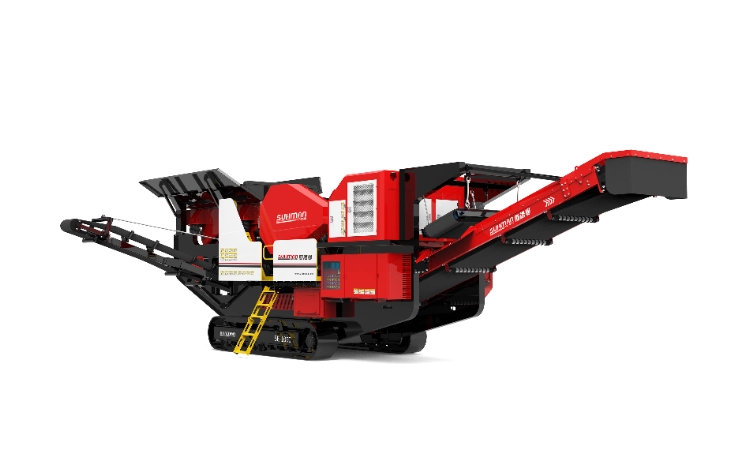



A mobile crushing station is a type of crushing machinery composed of several key components, including a feeding unit, ship-shaped chassis, conveying system, crushing unit, and screening system. Among them, the power drive system—often referred to as the “heart” of the tracked mobile crushing station—mainly comes in five types. Below is an analysis of these five driving methods: direct + hydraulic drive, direct + electric drive, full hydraulic drive, mains electricity drive, and diesel-electric drive.
1. Direct + Hydraulic Drive
This method uses a diesel engine as the power source. A transfer case splits the output into two ends:
- One end is connected to a clutch or hydraulic coupling to drive the main crusher, which ensures higher efficiency and better energy savings.
- The other end powers a hydraulic pump group to provide hydraulic energy for track movement, material conveying, and auxiliary folding mechanisms.
This drive system is currently the mainstream choice for tracked crushers both china and internationally. It offers a compact layout and efficient power transmission. However, the operating cost is higher compared to mains-powered systems, which somewhat limits its widespread adoption in full crushing and screening setups.
2. Direct + Electric Drive
In this system, a diesel engine acts as the power source and outputs through a transfer case with three ends:
- The main output connects to a clutch or hydraulic coupling to power the crusher.
- The second output drives a pump group for track movement and other hydraulic actuators.
- The third output powers a generator, which in turn drives electric motors responsible for feeding and conveying operations—offering more flexibility and efficiency.
This method retains the mobility and quick on-site operation advantages of tracked equipment. Additionally, it simplifies and reduces the number of hydraulic components, lowering maintenance complexity. However, due to the high power requirements of the travel system, the pump group must be large, increasing production costs and space demands. Furthermore, like other diesel-based systems, operating costs remain relatively high.
3. Full Hydraulic Drive
Here, the diesel engine drives a series of pump groups that generate hydraulic pressure to power the entire system. This includes:
- Track movement and equipment folding/unfolding,
- The feeder, crusher, and conveyor belts,
- The main crusher is powered by a dedicated variable displacement plunger pump, while other actuators are controlled by additional pump and valve groups.
This drive system allows for precise control of speed, overload protection, and automatic material discharge. It features a relatively simple layout, lower production cost, and ease of installation. However, it is mostly used in smaller mobile crushers due to the high torque required during the crusher’s start-up and the high-speed operation during normal use. Also, many of the hydraulic components need to be imported, which increases overall usage costs.
4. Mains Electricity Drive
For this method, the movement system is powered by a diesel engine driving a hydraulic pump group, which controls the track motors. All other operational functions are powered by mains electricity.
This setup can significantly reduce energy costs for users. It also allows for more spacious internal design and easier maintenance. Many domestically produced semi-mobile crushing stations use this configuration. The primary limitation is its restricted application range, as it requires a power supply and cable setup on-site—something not always available in mining or construction waste disposal environments.
5. Diesel-Electric Hybrid Drive
This hybrid system uses either mains electricity or a diesel generator as the power source.
- The movement function is handled by an electric motor combined with a hydraulic pump group.
- Other operational units are powered entirely by electric motors.
Much like a plug-in hybrid car, this method represents a future trend in tracked mobile crushing equipment. It enables the machine to connect to mains power for cost-effective operation during large projects, or switch to diesel engines for flexibility in smaller or more remote sites. The main drawbacks are its high manufacturing cost, structural complexity, limited internal space, and more challenging maintenance requirements.
Summary
The five driving methods of tracked mobile crushers each come with their own advantages and limitations. Since there are many types of tracked mobile crushers with different drive systems, it’s essential to consider the drive method when selecting the right equipment for your application.