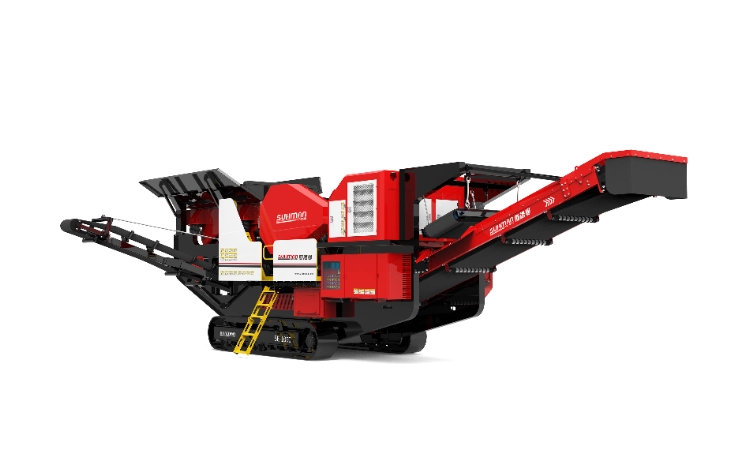


For granite and basalt, 200–300 TPH mobile lines are often the most practical choice for quarry operators and contractors: strong throughput, manageable transport logistics, and flexible product sizing without building a fixed plant. The key is matching feed size + target outputs + power source to a configuration that won’t choke under hard rock loads.
1) Recommended Configurations for Granite/Basalt (200–300 TPH)
Option A: “Classic Hard Rock” — Mobile Jaw + Mobile Cone + Mobile Screen
Best for: granite/basalt, high abrasion, consistent cubic aggregates
Process:
- Stage 1 (Primary): Mobile jaw crusher (heavy-duty, wide feed opening)
- Stage 2 (Secondary): Mobile cone crusher (high crushing force, stable gradation)
- Stage 3 (Sizing): 3-deck or 4-deck mobile screen
Why it works: cone is usually the most stable choice for hard, abrasive stone when you need high output + controlled shape.
Typical equipment list (example):
- Tracked jaw crusher + pre-screen
- Tracked cone crusher (with recirculation conveyor)
- Tracked screen (3-deck / 4-deck)
- Optional: stackers (reduce re-handling), dust suppression, magnet (when recycling)
Option B: “More Cubical” — Mobile Jaw + Mobile Impact + Mobile Screen
Best for: when you want more cubical shape for asphalt/concrete mixes
Process: Jaw → Impact → Screen
Trade-off: impact can give better shape, but wear cost can be higher on very abrasive basalt. If your basalt is extremely hard/abrasive, cone is usually more economical long-term.
Option C: “Closed-Circuit Single Train” — Jaw/Impact with Return Conveyor + Screen
Best for: job sites with tight space and fast commissioning
Process: Crusher + screen integrated in a closed circuit
Benefit: fewer machines, faster setup
Note: Make sure the return load (recirculation) doesn’t overload the crusher in hard rock conditions—this is where correct screen aperture + crusher setting matters.
2) Feed Size & Crusher Settings That Actually Hold 200–300 TPH
Granite/basalt performance depends heavily on consistent feeding and correct CSS (closed-side setting).
Practical tips for stable throughput:
- Use a vibrating grizzly feeder + pre-screen to bypass fines before the jaw.
- Keep a steady feed level—avoid surging (it kills throughput and increases liner wear).
- If your max feed is large (e.g., 500–700 mm), choose a jaw that comfortably accepts it, not “barely fits”.
3) Output Size “Recipes” (Most Common Aggregate Demands)
Below are typical marketable products for granite/basalt. Exact results depend on your stone, moisture, and required shape.
Recipe 1: Concrete & Asphalt Standard Mix
Outputs: 0–5 mm, 5–10 mm, 10–20 mm, 20–31.5 mm
Suggested layout: Jaw + Cone + 3-deck screen
- Decks set to make 0–5, 5–10, 10–20
- Oversize returns to cone (closed-circuit)
- Optional 4th deck if you need 20–25 and 25–31.5 separately
Recipe 2: Road Base + Mixed Aggregates
Outputs: 0–5 mm, 0–31.5 mm, 31.5–63 mm
Suggested layout: Jaw + screen (or jaw + cone + screen)
- If you want more base material and fewer fractions, simplify the screening and maximize tons/hour.
Recipe 3: High Cubical for Premium Asphalt
Outputs: 0–3 mm sand, 3–8 mm, 8–16 mm, 16–22 mm
Suggested layout: Jaw + Cone (or Impact) + 4-deck screen
- Consider shaping stage (cone with shaping chamber or impact if wear is acceptable)
4) Screening Choices: 3-Deck vs 4-Deck (What You Gain)
- 3-deck screen: most common; produces 3 finished sizes + oversize return
- 4-deck screen: more flexibility; better when you must supply multiple strict fractions or want to reduce re-handling/secondary screening
If your buyers demand tight gradation bands, the screen selection is often more important than upgrading crusher power.
5) Power Options: Diesel, Electric, Hybrid — Which Fits Your Site?
Diesel-Hydraulic (Most Flexible)
Best for: remote quarry sites, frequent relocations
Pros: independent, fast deployment
Cons: fuel cost, emissions controls
Diesel-Electric
Best for: strong power delivery, easier control, can integrate with site electricity later
Pros: efficient load management, stable crusher speed
Cons: slightly higher complexity
Fully Electric (Grid)
Best for: long-term quarry operation with grid access
Pros: lowest operating cost (usually), quieter, easier emission compliance
Cons: requires stable power supply, cable management, less “instant move”
Hybrid (Grid + Diesel Backup)
Best for: sites with unstable grid or strict emissions targets
Pros: flexibility + cost savings
Cons: system design must be done properly (power distribution, protection)
6) Key Options That Improve Real Production (Not Just Brochure Specs)
- Pre-screen module: bypass fines → higher jaw capacity + lower wear
- Recirculation (closed circuit): consistent product sizes
- Dust suppression: stable site operations, easier compliance
- Remote control + monitoring: safer relocation/feeding control
- Spare parts kit: liners, belts, rollers—reduces downtime risk on projects
7) What We Need From You to Recommend the Best Line
To select the right 200–300 TPH configuration, we usually confirm:
- Material: granite/basalt type, abrasiveness, moisture
- Max feed size & desired finished sizes
- Target capacity (avg vs peak)
- Power preference: diesel / electric / hybrid
- Mobility needs: tracked vs wheeled, relocation frequency
- End-use requirements: asphalt/concrete/road base (shape + gradation)
FAQ (10)
1) Can a 200–300 TPH mobile plant handle basalt reliably?
Yes—if the jaw is sized for feed, the secondary stage is properly selected (often cone for basalt), and you use pre-screening to reduce unnecessary crushing.
2) Jaw + cone or jaw + impact for granite/basalt?
Jaw + cone is usually the most economical and stable for hard, abrasive rock. Jaw + impact can improve shape, but wear can be higher in very abrasive basalt.
3) What output sizes are most requested in quarry markets?
Common fractions are 0–5 mm, 5–10 mm, 10–20 mm, and 20–31.5 mm for concrete/asphalt; road base often uses 0–31.5 mm.
4) Do I need a 4-deck screen?
Choose 4-deck when you must supply multiple strict fractions simultaneously or want to reduce re-screening and re-handling.
5) What is “closed-circuit” crushing and why is it important?
Closed-circuit means oversize returns for re-crushing. It stabilizes gradation and improves consistency of finished products.
6) How do I maximize capacity without increasing crusher size?
Use a grizzly pre-screen to bypass fines, maintain consistent feeding, and optimize crusher settings (CSS) and screen apertures.
7) Diesel or electric—what is cheaper long-term?
If you have stable grid power, fully electric is often cheaper to run. For remote sites, diesel provides flexibility. Hybrid is a strong middle option.
8) Tracked or wheeled—what should I choose?
Tracked is best for frequent moves on rough ground and working close to the face. Wheeled can be cost-effective for smoother sites with towing logistics.
9) How fast can a mobile line be installed and start production?
Mobile units are designed for rapid commissioning. Actual time depends on site preparation, power setup, and conveyor layout.
10) What information do you need to quote the right plant?
Material type, feed size, required outputs, target capacity, power preference, and mobility requirements.
Call to Action
Send us your material type, max feed size, required output sizes, and target capacity, and we’ll recommend the best 200–300 TPH configuration and provide a factory quote for your project (distributors, contractors, and quarry owners welcome).