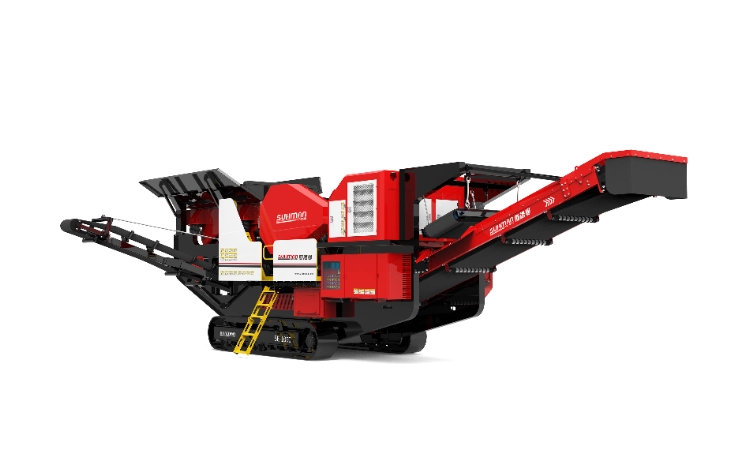



A mobile crusher quotation should be more than a machine model followed by a price.
A useful quotation should explain how the proposed equipment will process your actual feed material, achieve the required saleable output, fit the jobsite and meet the project’s power, transport and operating conditions.
That is why a request such as “I need a 200 TPH mobile crusher” is not enough for final equipment selection.
A 200 TPH granite quarry, a 200 TPH limestone operation and a 200 TPH reinforced-concrete recycling project may require different crushers, screens, wear parts and auxiliary equipment. Their purchase prices and operating costs can also differ substantially.
This guide explains the nine project details a supplier needs before preparing an accurate mobile crusher quotation.
What Information Should You Send First?
For an initial mobile crushing plant recommendation, send these five details:
- The material to be processed
- The maximum feed size
- The required saleable capacity
- The required final product sizes
- The project country and jobsite location
Material photographs, a simple site layout and an expected operating schedule will make the preliminary proposal more useful.
Why Capacity Alone Is Not Enough
Crusher capacity is not determined by the machine name alone. It is affected by several project-specific conditions:
- Material hardness and abrasiveness
- Maximum feed size and feed gradation
- Moisture, clay and fines content
- Required final product sizes
- Crusher setting and screening arrangement
- Recirculating load in a closed circuit
- Feeding consistency
- Site altitude and ambient temperature
- Power source and daily operating schedule
Jaw crushers are generally used for primary reduction. Cone crushers are commonly selected for secondary or tertiary crushing of harder, more abrasive rock. Horizontal-shaft impact crushers are often considered for limestone, concrete recycling and other low-to-medium-hardness materials, while VSI crushers are normally used at the final shaping or manufactured-sand stage.
The correct purchasing question is therefore not simply:
How much does a 200 TPH mobile crusher cost?
A more useful question is:
What mobile crushing and screening configuration can turn my feed material into the required saleable products at approximately 200 TPH?
The 9 Details Required for an Accurate Mobile Crusher Quotation
| Project information | What to provide | Why it affects the quotation |
|---|---|---|
| 1. Feed material | Rock type, demolition waste type or mineral | Determines crusher type and wear-part selection |
| 2. Feed size | Maximum lump size and typical gradation | Determines feed opening, feeder and primary crusher |
| 3. Required capacity | Saleable TPH and operating hours | Determines machine size and number of crushing stages |
| 4. Final products | Required sizes, proportions and end use | Determines crusher settings, screens and recirculation |
| 5. Material condition | Moisture, clay, fines, rebar and contaminants | Determines pre-screening and auxiliary equipment |
| 6. Site conditions | Terrain, space, climate, altitude and relocation frequency | Affects chassis, layout, cooling and mobility requirements |
| 7. Power requirements | Diesel, grid electric, generator or dual power | Affects equipment configuration and operating cost |
| 8. Supply scope | Single crusher or complete plant | Determines what is included in the commercial offer |
| 9. Destination and terms | Country, port, Incoterm and target delivery date | Determines freight, compliance and delivery planning |
1. What Material Will Be Processed?
Start with the exact feed material.
For a quarry or mining project, identify the rock or mineral as specifically as possible:
- Granite
- Basalt
- Diabase
- River stone
- Limestone
- Dolomite
- Sandstone
- Iron ore
- Copper ore
- Other mineral-bearing rock
For a recycling project, describe the waste stream:
- Reinforced concrete
- Non-reinforced concrete
- Asphalt
- Bricks and blocks
- Mixed demolition waste
- Slag
- Excavated material
Do not describe the feed only as “stone” or “construction waste.” Those terms are too broad for reliable equipment selection.
Where available, provide the material’s compressive strength, abrasion characteristics, bulk density or laboratory report. When test data is unavailable, send several clear photographs showing freshly broken material, larger feed pieces and the proportion of fines.
The supplier must understand not only what the material is called, but also how it is likely to behave inside the crusher.
2. What Are the Maximum and Typical Feed Sizes?
The maximum lump size affects the feeder, crusher opening and risk of blockage.
Provide two measurements:
- Maximum feed size: the largest piece that may enter the plant.
- Typical feed size or gradation: the normal distribution of coarse material and fines.
For example, “maximum feed size 650 mm” is more useful than “large stone,” but it still does not describe the complete feed condition.
A plant receiving mostly 100–300 mm material with occasional 650 mm pieces behaves differently from a plant that receives a continuous high percentage of 500–650 mm rock.
When possible, include:
- Maximum length, width and thickness of oversized pieces
- Approximate percentage of material below 50 mm
- Approximate percentage of material above 300 mm
- Feeding method: excavator, wheel loader, dump truck or upstream crusher
- Whether a hydraulic breaker will be available for oversized material
A photograph with a measuring tape, loader bucket or another scale reference can help the engineering team judge the feed more accurately.
3. What Capacity Do You Actually Need?
State the required saleable production rate, not only the theoretical crusher throughput.
Useful production information includes:
- Required tonnes per hour
- Hours per shift
- Shifts per day
- Planned production days per year
- Peak production requirement
- Minimum acceptable continuous output
- Expected future expansion
Suppose the project needs 200 tonnes per hour of finished 0–5 mm, 5–20 mm and 20–40 mm aggregate. The crusher may need to process more than 200 tonnes per hour internally because oversized material can return through the closed circuit.
For this reason, suppliers should state the assumptions behind their quoted capacity.
A professional proposal should clarify whether the stated output refers to:
- Primary crusher throughput
- Total circuit feed
- Finished saleable product
- One finished product size
- Combined production across all product sizes
Without this distinction, two quotations that both say “200 TPH” may not be commercially comparable.
4. What Final Product Sizes Are Required?
Final output requirements determine the number of screens, screen decks, conveyors and crushing stages.
Provide every required product size, for example:
- 0–5 mm
- 5–10 mm
- 10–20 mm
- 20–40 mm
- 0–31.5 mm road base
- 0–45 mm sub-base
- Manufactured sand
- Single-size drainage stone
Also explain the intended use of the finished product:
- Concrete aggregate
- Asphalt aggregate
- Road base
- Railway ballast
- Drainage material
- Manufactured sand
- Backfilling
- Recycled aggregate
- Material for further processing
The same nominal size can require different equipment depending on particle shape, fines content and grading requirements.
For concrete and asphalt aggregate, particle shape and grading control may be more important than for general fill. A VSI shaping stage may be considered when the project requires improved cubical shape or additional manufactured sand.
Need a Preliminary Mobile Crushing Configuration?
Send your material, maximum feed size, required capacity, final product sizes and project country. These five details allow the technical team to prepare a more relevant preliminary configuration instead of sending a generic price list.
5. Is the Feed Wet, Sticky, Clay-Rich or Contaminated?
Moisture, clay and excessive fines can reduce effective capacity and cause material to adhere to feeders, crushers, conveyors and screen media.
Wet or sticky material may require pre-screening, scalping, different screen media or a modified process arrangement.
Tell the supplier whether the feed contains:
- Wet clay
- Soil
- A high proportion of fines
- Reinforcing steel
- Wood
- Plastic
- Oversized metal
- Asphalt
- Other uncrushable objects
For construction and demolition waste, an upstream pre-screen can remove soil and fines before crushing. A magnetic separator can remove exposed reinforcing steel after the crusher. Dust-suppression equipment may also be required depending on the material and local regulations.
Do not assume these components are included in every mobile crusher quotation. Ask the supplier to list standard and optional equipment separately.
6. What Crushing Circuit Fits the Project?
There is no universal mobile crushing plant for every material.
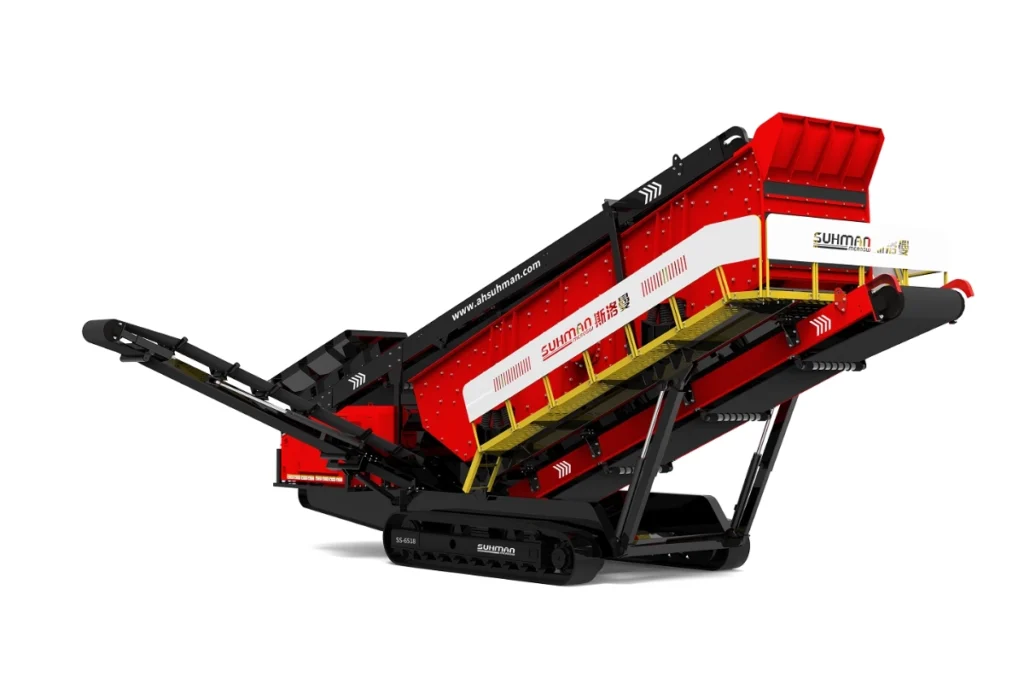
SUHMAN’s product range includes tracked mobile crushing plants, jaw crushers, cone crushers, impact crushers, VSI crushers and screening equipment. Final machine selection should be confirmed after the material and product requirements have been reviewed.
| Project condition | Typical starting configuration | Relevant SUHMAN equipment families |
|---|---|---|
| Hard, abrasive rock such as granite, basalt or diabase | Mobile jaw crusher + mobile cone crusher + screen | SE-series mobile jaw crusher + SY-HP300 mobile cone crusher + screening plant |
| Limestone, dolomite and other low-to-medium-hardness rock | Mobile impact crusher, or jaw crusher + impact crusher + screen | SF-series mobile impact crusher with screening equipment |
| Reinforced concrete and mixed demolition waste | Jaw or impact crusher + pre-screen + magnetic separator + screen | SE-series or SF-series plant, selected according to feed and steel content |
| One compact plant producing two fractions | Integrated impact crushing and screening plant | SF-580D-S integrated crushing and screening configuration |
| Manufactured sand or final aggregate shaping | Primary and secondary crushing + VSI + final screen | SC-85D VSI crusher with mobile screening plants |
| Smaller sites or lower-volume projects | Compact mobile jaw crusher + suitable screen | SE-650D compact mobile jaw crusher |
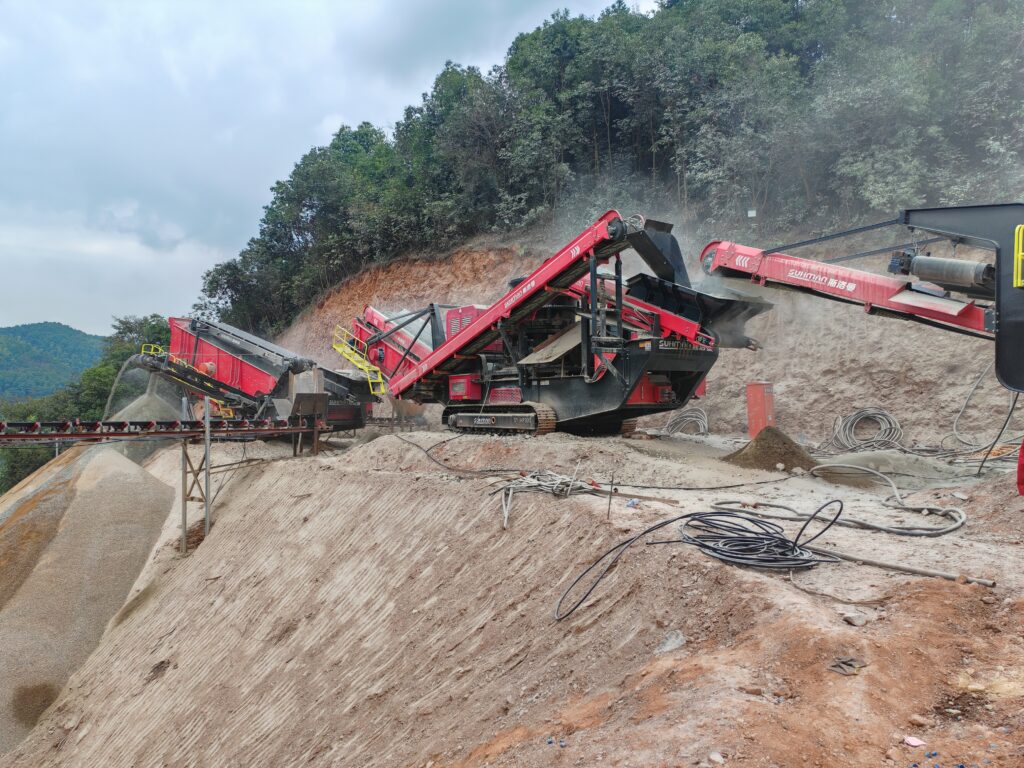

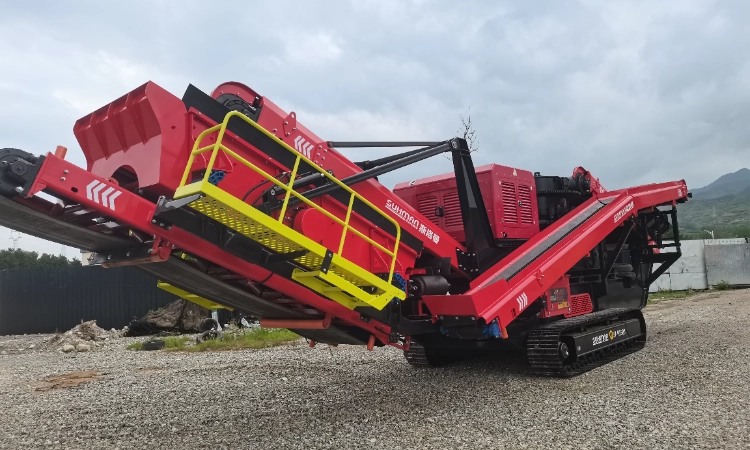

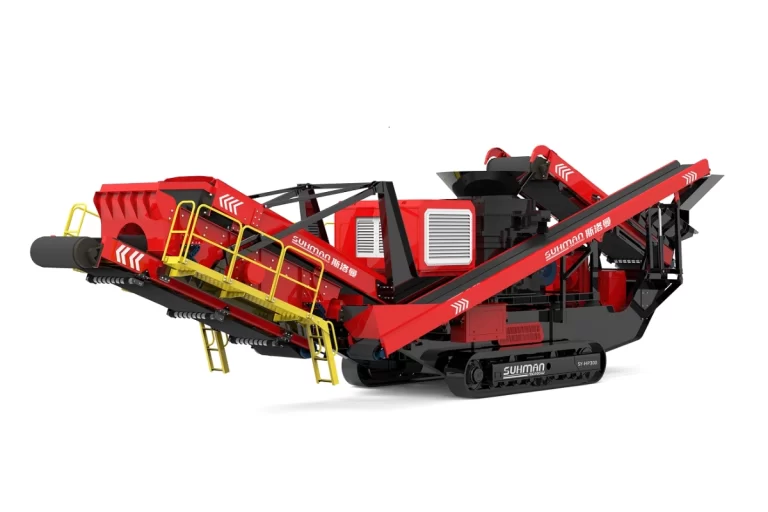
The table provides an initial decision framework rather than a final model recommendation. Actual configuration depends on feed gradation, material characteristics, required output and operating conditions.
Hard and Abrasive Rock
A jaw crusher is commonly used for primary reduction because it can accept larger feed. A cone crusher then handles secondary or tertiary reduction and is generally better suited to abrasive rock than a conventional impact crusher.
A screen separates the finished products and returns oversized material to the cone crusher when a closed circuit is required.
Limestone and Medium-Soft Rock
An impact crusher can provide a simpler process for limestone, dolomite, concrete and similar materials. Depending on feed size and target output, the project may use:
- A single closed-circuit mobile impact plant
- A jaw crusher followed by an impact crusher
- An impact crusher followed by a separate screen
The correct arrangement depends on the required reduction ratio, wear rate, finished-product shape and number of final product sizes.
Construction and Demolition Waste
A recycling plant should be selected around the actual waste stream.
Reinforced concrete may require a different feed and separation arrangement from clean concrete blocks. Mixed demolition waste may need pre-screening to remove soil before crushing.
Important options can include:
- Heavy-duty feeder
- Independent pre-screen
- Magnetic separator
- Water-spray dust suppression
- Picking station
- Return conveyor
- Interchangeable screen media
- Remote-controlled tracked movement
7. What Are the Site, Mobility and Power Conditions?
A tracked machine can move around a quarry or demolition site, but the supplier still needs to understand how the plant will be used.
Provide the following site information:
- Available installation area
- Ground condition and slope
- Access-road width
- Maximum transport weight or height
- Frequency of relocation
- Distance between working faces
- Ambient temperature range
- Site altitude
- Dust and noise restrictions
- Availability of grid electricity
- Required voltage and frequency
Also state the preferred power arrangement:
- Diesel-hydraulic
- Diesel-electric
- External grid electricity
- Generator-powered operation
- Dual-power configuration
A quarry with stable grid power may prioritise electrical operation. A demolition contractor moving between short-term projects may place greater value on independent diesel operation and faster relocation.
Power preference should therefore be confirmed before the supplier calculates the final equipment scope and operating-cost assumptions.
8. What Must Be Included in the Supply Scope?
A low quotation may cover only the main crusher. A higher quotation may include a complete working plant.
Before comparing prices, confirm whether each proposal includes:
- Feeding hopper
- Vibrating feeder
- Pre-screen
- Primary crusher
- Secondary crusher
- Return conveyor
- Final screening plant
- Discharge conveyors
- Magnetic separator
- Dust-suppression system
- Diesel generator
- Remote control
- Central lubrication
- Metal detector
- Platforms and guards
- Initial wear parts
- Recommended spare-parts package
- Commissioning
- Operator training
- Technical documentation
- Freight and insurance
Ask the supplier to separate standard equipment from optional equipment.
The quotation should also identify components that must be supplied locally, such as cables, water tanks, foundations, loaders, excavators or external conveyors.
9. Where Will the Equipment Be Delivered?
The destination influences freight, machine configuration and documentation.
Provide:
- Project country
- Final jobsite location
- Nearest seaport
- Preferred Incoterm
- Road or bridge restrictions
- Local voltage and frequency
- Engine-emission requirements
- Required certificates
- Target delivery date
A factory price, FOB price, CIF price and delivered-to-site price represent different commercial scopes. They should not be compared as though they were the same.
For inland projects, also clarify whether the supplier is expected to arrange transport from the destination port to the final jobsite.
How to Compare Mobile Crusher Quotations Fairly
Do not compare only the total price shown at the bottom of each quotation.
Use the following comparison checklist.
| Comparison item | What to verify |
|---|---|
| Capacity basis | Material, feed size, moisture, crusher setting and final products assumed |
| Equipment scope | Every crusher, screen, conveyor and auxiliary component included |
| Finished-product output | Whether quoted TPH refers to total feed or saleable products |
| Power configuration | Engine, motor, generator, grid connection and installed power |
| Wear parts | Materials, expected service conditions and initial spare quantities |
| Transport | Number of transport units, dimensions, weights and dismantling required |
| Controls and safety | Remote control, guarding, emergency stops and monitoring functions |
| Warranty | Covered components, warranty start date, exclusions and claim procedure |
| Service | Remote support, commissioning, training and engineer availability |
| Commercial terms | Incoterm, payment terms, quotation validity, delivery time and exclusions |
A quotation becomes meaningful only when all suppliers are working from the same project assumptions.
For example, one offer may include a pre-screen, return conveyor, generator and spare-parts package, while another includes only the crusher. The second offer may look cheaper but still require significant additional investment before production can begin.
Copy-and-Paste Mobile Crusher RFQ Template
Use the following template when contacting a mobile crusher supplier:
PROJECT INFORMATION

Project country:
Final jobsite location:
Nearest seaport:
Target purchase or delivery date:
Preferred Incoterm:

MATERIAL

Material name:
Material application:
Maximum feed size:
Typical feed-size range:
Material hardness or compressive strength, if known:
Moisture or clay content:
Does the feed contain rebar, metal, soil or other contaminants?
Material photos or test report available: Yes / No

PRODUCTION REQUIREMENTS

Required saleable capacity:
Operating hours per day:
Required final product sizes:
Estimated percentage of each product:
End use of the finished material:
Required particle-shape or grading standard:

SITE AND POWER

Available installation area:
How often will the plant be relocated?
Site altitude:
Ambient temperature range:
Grid power available: Yes / No
Required voltage and frequency:
Preferred power mode: Diesel / Electric / Dual Power

SUPPLY SCOPE

Single machine or complete crushing and screening plant:
Pre-screen required: Yes / No / Not Sure
Magnetic separator required: Yes / No / Not Sure
Dust suppression required: Yes / No / Not Sure
Generator required: Yes / No / Not Sure
Spare-parts package required: Yes / No
Commissioning and training required: Yes / No
Attaching material photographs, a simple site layout and a sample-product specification will normally produce a more useful response than sending only a capacity requirement.
What a Useful Preliminary Proposal Should Contain
After reviewing the RFQ, the supplier should be able to provide a preliminary proposal containing:
- Recommended process flow
- Proposed crusher and screen models
- Capacity and feed assumptions
- Expected final product arrangement
- Included and optional equipment
- Installed power and power mode
- Transport dimensions and weights
- Preliminary layout
- Wear- and spare-parts recommendation
- Commercial price and delivery terms
- Warranty and service scope
- Clear exclusions and items requiring confirmation
Be cautious when a supplier provides a final machine recommendation without asking about the material, maximum feed size or required final products.
Frequently Asked Questions
Can I Get a Mobile Crusher Price by Providing Only the Required Capacity?
You can receive a budgetary price, but it may not represent the correct plant. Material, feed size, final products, moisture, site conditions and supply scope must be reviewed before the supplier can prepare a reliable commercial quotation.
Why Do Mobile Crusher Capacity Ranges Appear So Wide?
Published capacity ranges cover different materials and operating conditions. Actual output depends on feed gradation, material hardness, moisture, crusher setting, screen configuration, recirculating load and feeding consistency.
Ask the supplier to state the assumptions used for the quoted capacity.
Should I Choose a Jaw–Cone or Jaw–Impact Configuration?
A jaw–cone circuit is generally considered for harder and more abrasive rock such as granite and basalt. A jaw–impact circuit can be suitable for limestone, concrete recycling and other low-to-medium-hardness materials.
The final choice should also consider finished-product shape, wear cost, feed gradation and required reduction ratio.
Do I Need a Separate Screening Plant?
A separate screen is normally required when the project must produce several controlled product sizes or operate a closed crushing circuit.
An integrated crusher-and-screen plant may be sufficient for some smaller or simpler projects. A separate screening plant usually provides greater flexibility when more product fractions or higher screening capacity are required.
Can a Mobile Crusher Process Reinforced Concrete?
Yes, but the amount and form of reinforcing steel must be assessed. The plant may require a suitable feeder, pre-screen and magnetic separator. Large exposed steel should be removed before feeding whenever possible.
What Information Should I Send First for a Preliminary Recommendation?
Start with these five items:
- Material
- Maximum feed size
- Required capacity
- Final product sizes
- Project country
Add material photographs and any available test information whenever possible.
Order & Project Support
The right mobile crusher quotation begins with a clear project brief.
Send SUHMAN your material, maximum feed size, required capacity, final product sizes and project location. Based on this information, the technical team can prepare a preliminary crushing and screening configuration and identify the main equipment, optional components and project conditions that still require confirmation.
Get a Project-Specific Mobile Crusher Configuration
Submit your material, feed size, required TPH, final product sizes and project country. Receive a preliminary equipment configuration and quotation scope for your mobile crushing project.
Note: Published equipment capacities are reference ranges rather than unconditional production guarantees. Actual plant output depends on material characteristics, feed gradation, moisture, crusher settings, screening configuration, operating conditions and feeding consistency.